


If you are planning to climb the world’s highest peak or even just trek to its base, it is natural to be concerned about safety. Honestly, many people assume that because Mount Everest is the tallest mountain on Earth, it must be the deadliest. Actually, the data tells a much more surprising story.
While you should always be careful at high altitudes, remarkably, Everest doesn’t even make the top five deadliest mountains in the world. According to NASA and recent Himalayan database records, Everest sits at #10 on the list of deadliest peaks. In short, while the mountain demands respect, it is statistically safer than many of its 8,000m neighbors.
The Survival Stats: Everest vs. The “Deadly Nine”
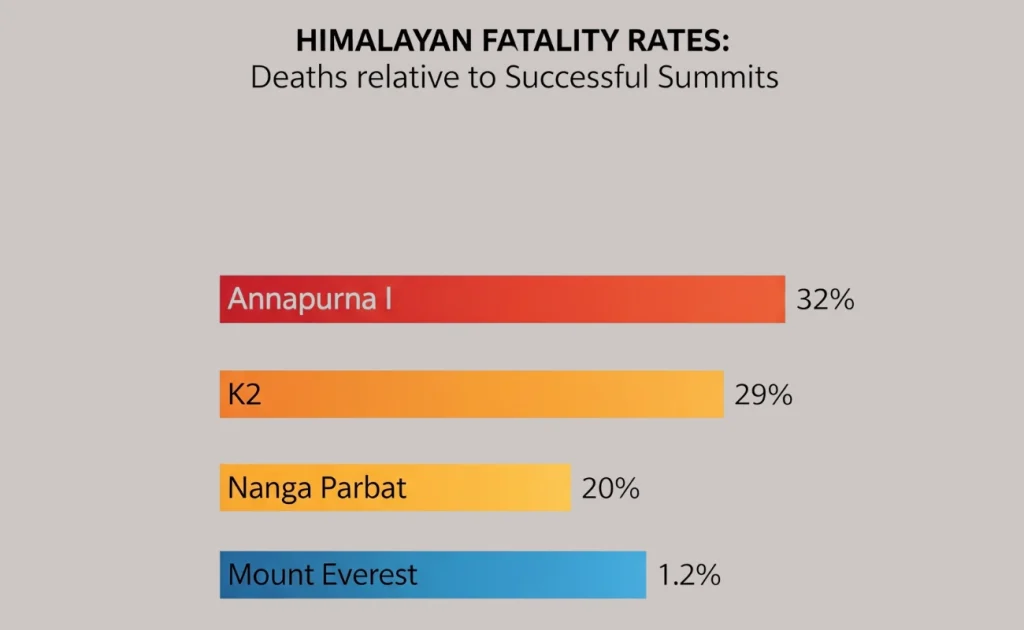
Crucially, if we look at the fatality-to-summit ratio, there are nine other mountains that are significantly more dangerous than Everest.
| Mountain | Peak Height | Fatality Rate |
|---|---|---|
| Annapurna I | 8,091m | ~32% |
| K2 (Godwin-Austen) | 8,611m | ~29% |
| Nanga Parbat | 8,126m | ~20% |
| Mount Everest | 8,848.86m | ~1.2% |
Basically, for every 100 climbers who stand on the summit of Annapurna I, 32 do not survive the descent. On Everest, less than 2 people die for every 100 successful summits. Consequently, while Everest is the highest, it is not the “killer mountain” many think it is.
Current Data: Death Rate on Everest in 2026
s of our most recent 2026 data updates, the average death rate on Mount Everest remains between 1% and 1.2%.
Ultimately, this means that roughly 1 out of every 100 climbers who attempt the summit will not survive. Since the first attempts in the 1920s, over 335 climbers have lost their lives on the mountain. However, it is important to note that the majority of these deaths occur during the summit push or the descent – not during the standard 15 Days Everest Base Camp Trek.
That means out of every 100 climbers who successfully reach the summit, around 1 climber does not survive the journey.
The “Death Zone” and Main Causes of Fatality
Why do people die on Everest? Honestly, most deaths occur above 8,000 meters, in the area known as the “Death Zone.” At this altitude, oxygen levels are so low that the human body begins to die, minute by minute.

Actually, the leading causes of death are:
- Main causes of death:
- Avalanches
- Falls
- Exposure to extreme cold (hypothermia)
- Altitude sickness (including HAPE and HACE)
- Exhaustion during descent
- Most dangerous zone: The “Death Zone” (above 8,000 meters / 26,247 feet), where oxygen is very low and the body cannot survive for long.
Recent Trends: Is Everest Getting Safer?
Remarkably, the answer is yes and no.
On one hand, better gear, high-definition weather forecasting, and the incredible support of expert Sherpas have made the journey more predictable. Furthermore, companies like Pristine Nepal now use medical-grade oximeters to monitor clients daily, significantly reducing the risk of altitude-related emergencies.
On the other hand, overcrowding and “inexperienced” climbers are the new risks. When too many people try to pass through the Hillary Step at once, it creates a “bottleneck” in the Death Zone. Therefore, choosing a luxury approach like the Luxury Everest Base Camp is often a safety decision, as it ensures you have the best guides and the most flexible logistics to avoid these crowds.
Summary: Safety Over Ego
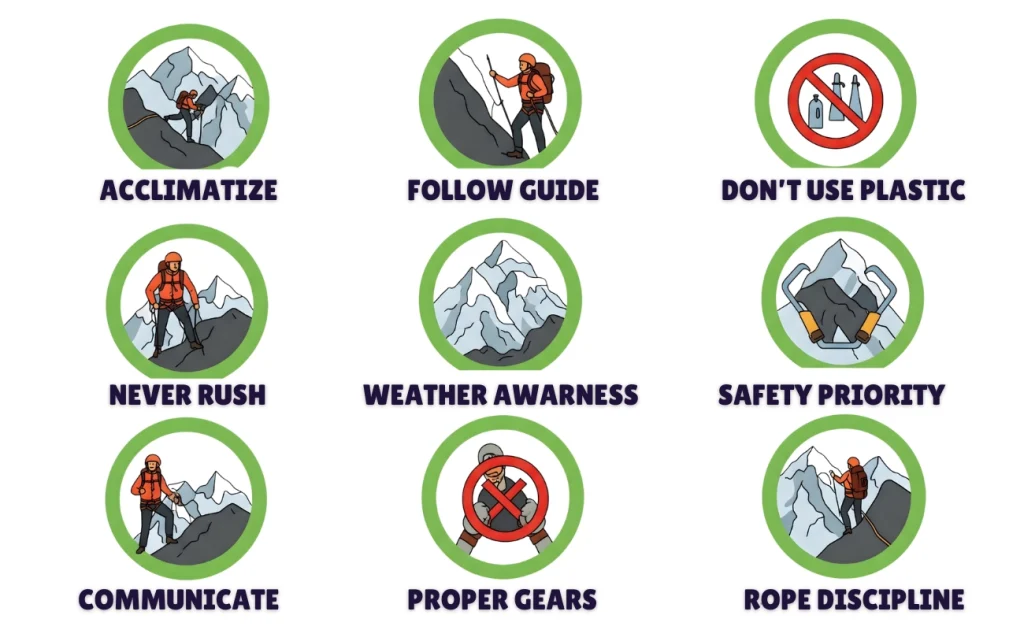
Ultimately, the death rate on Mount Everest is a reminder that the Himalayas are indifferent to human ambition. Basically, the mountain doesn’t care about your bucket list; it only cares if you are prepared.
At Pristine Nepal Treks and Expedition, we maintain a 100% safety record on our trekking routes because we prioritize your health over the summit. We don’t just “walk” – we monitor. We don’t just “guide” – we protect.
Ready to see Everest safely? If you aren’t ready to climb the 8,848m peak, start your journey with a trek to the base. It’s the best way to experience the giant without entering the Death Zone.
Check our 2026/27 EBC Trek Availability Today
