


1. Introduction: The Climb Beyond the Walk
You’ve trekked high in the Himalayas, seeing the giants up close. You’ve endured the altitude, seen the Khumbu Icefall, and maybe even stood on Kala Patthar. But let’s be honest: what you’ve been doing is high-altitude trekking. Real mountaineering? That’s a completely different beast, and it’s what sets the Himalayan legends apart.
Technical mountaineering in Nepal isn’t just about surviving thin air; it’s about safely clipping into a fixed line, jamming a Jumar up vertical ice, and knowing how to swing an axe for self-arrest. It requires a harness, specialized boots, and most importantly, mandatory, life-saving rope skills.
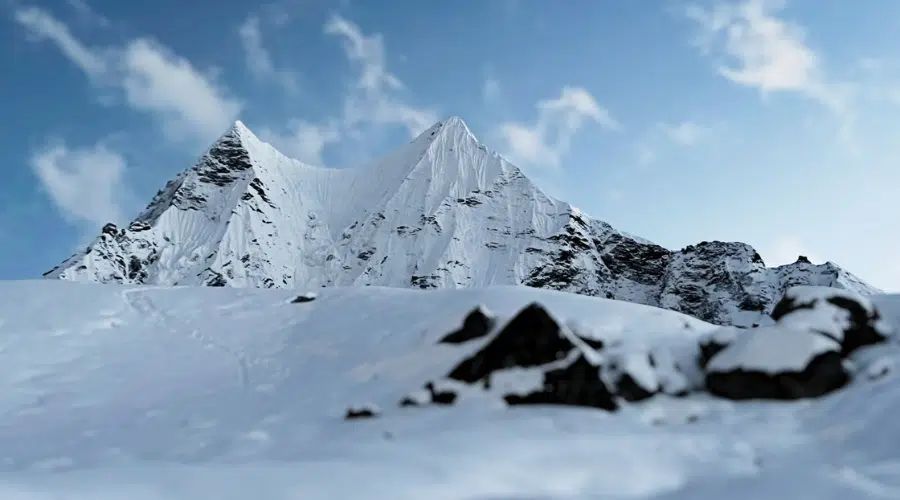
I’m the owner of Pristine Nepal Treks and Expedition, and for years, we’ve guided ambitious adventurers who want to know how to transition from a hiker to a climber. Consequently, we structured our expeditions based on the official climbing categories defined by the Nepal Mountaineering Association (NMA) to give you a transparent, clear path.
First, we’ll look at the foundational skills of high-altitude trekking. Then, we’ll zero in on the glorious, semi-technical Trekking Peaks—your perfect entry point. Finally, we’ll define the formidable world of true Expedition Peaks. Therefore, by the time you finish this guide, you’ll know exactly how to level up your game and choose your next summit goal.
2. Level 1: High-Altitude Trekking (The Non-Technical Baseline)
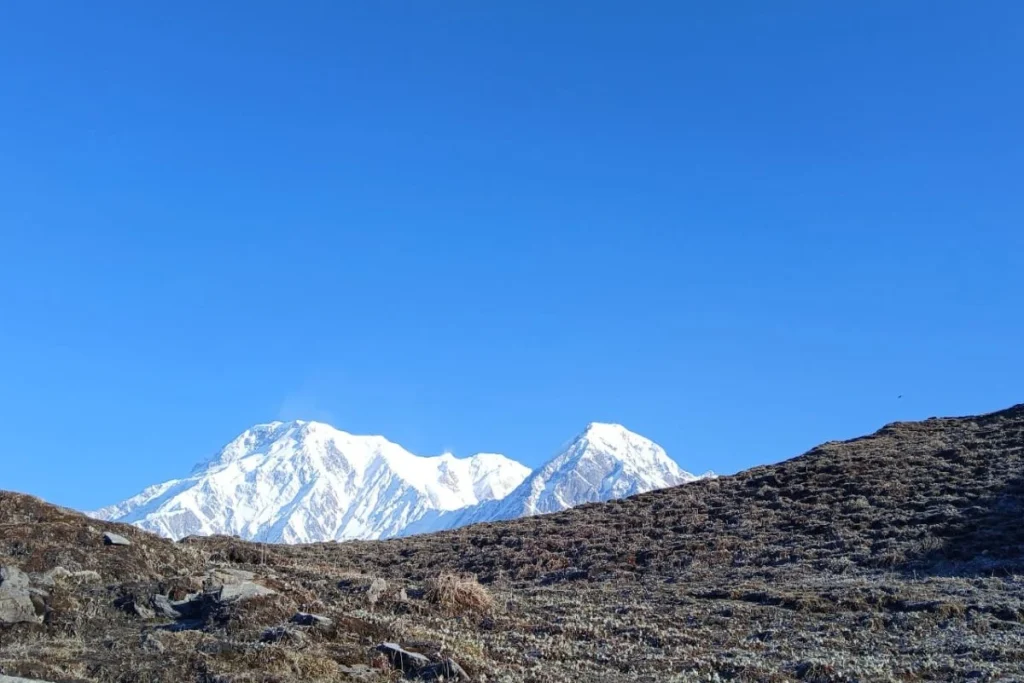
Level 1 is where we separate the serious hikers from the weekend warriors. This is the High-Altitude Trekking zone, and it’s the required foundation for everything else. Crucially, it is defined by its non-technical nature. You are walking on established trails—rocky, yes, and sometimes snowy—but trails nonetheless. You won’t use a harness, you don’t need to know how to set an anchor, and our guides will not be fixing ropes for you.
What High-Altitude Trekking Truly Requires:
If technical skill isn’t required, what is? Relentless endurance and meticulous self-care. You must respect this level, because the mountain will still break you if you are unprepared.
A. Cardiovascular Resilience: The Engine Room
Forget sprints; think sustained, efficient output. Success in the Khumbu means you can comfortably walk 6 to 8 hours daily for two weeks straight, carrying a 5-kilogram daypack. You must build your cardiovascular fitness to manage the low-oxygen environment. Consequently, every step above 4,000 meters feels like walking with a heavy blanket over your head. You have to be fit enough to not just walk, but to walk slowly and efficiently under constant oxygen stress. Furthermore, your training must simulate walking on uneven terrain, protecting your knees from the demanding long descents.
B. The Acclimatization Protocol: Your Survival Strategy
This is the most critical key to Level 1 success. Acute Mountain Sickness (AMS) is the real threat here, not crevasses. Our protocols, like the essential “climb high, sleep low” strategy, are designed to trick your body into adapting to the lack of oxygen. You must commit to these rules: hydrating constantly, eating carbohydrates, and listening immediately when your body whispers that something is wrong. Therefore, the primary focus shifts from conquering the mountain to intelligently managing your body’s reaction to the altitude.
C. The Iconic Trails: EBC and Annapurna
Classic routes like the Everest Base Camp (EBC) Trek or the Annapurna Circuit fall into this category. They are spectacular because they immerse you in the local Sherpa culture, deliver world-class views, and introduce you to the demands of altitude. You walk a defined path, typically stay in comfortable teahouses, and enjoy warm, nutritious meals. This is your essential training ground; it’s where you test your endurance, learn the altitude game, and prove your fundamental readiness to move onto Level 2.
3. Level 2: The Gateway – NMA Trekking Peaks (Semi-Technical)
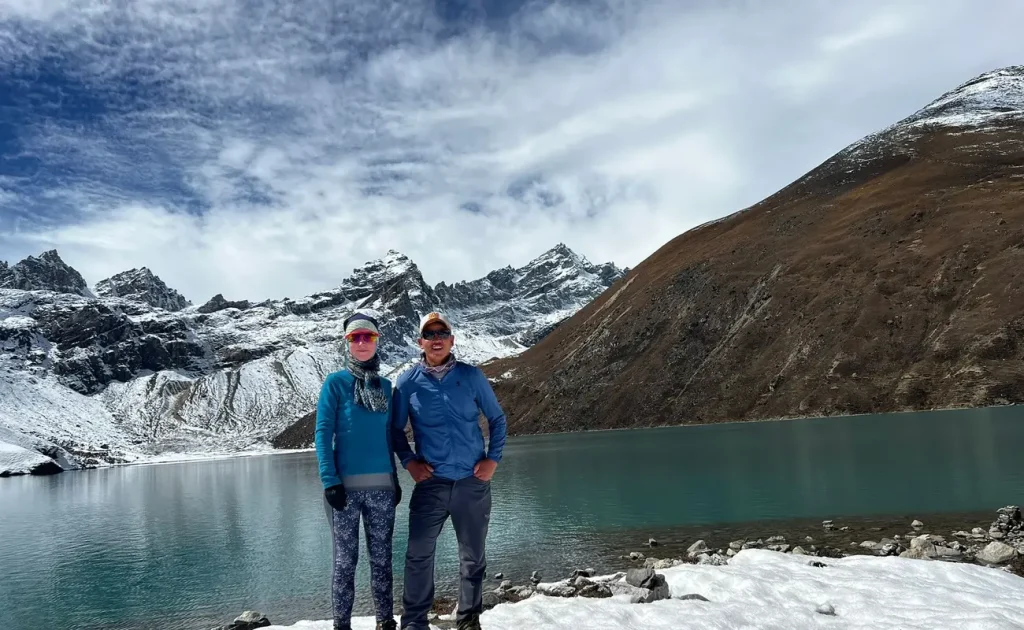
This is the point of no return—the glorious, adrenaline-fueled transition from a serious high-altitude hiker to a legitimate mountaineer. We call this Level 2: The NMA Trekking Peaks. Ranging from 5,800m to just over 6,500m, these mountains are intentionally managed by the Nepal Mountaineering Association to offer a controlled challenge. Crucially, this is the only way to earn your stripes in the Himalayas without committing years of training to a major expedition.
The Crucial Transition: Bridging the Divide
What defines this level is the mandatory requirement for specialized equipment. You are no longer just walking; you are performing essential climbing maneuvers. You must master the hardware: strapping on crampons to your high-altitude boots, clipping into your harness, carrying an ice axe, and relying entirely on fixed ropes for protection and movement on steep ice and snow. Therefore, we dedicate critical time at Base Camp to mandatory training. We teach you how to use a Jumar (ascender) and perform controlled abseiling (rappelling). You need zero prior experience, but you must be fit enough to execute these skills when it matters most.
Example Peak 1: Mera Peak (6,476m) – The Endurance Test
If your focus is conquering altitude rather than technical rock or ice, Mera Peak is often the perfect choice. Standing at a breathtaking 6,476 meters, it is one of the highest Trekking Peaks.
- Technical Grade: F (Facile) or PD- (Peu Difficile minus).
- The Reality: The route is primarily a relentless, multi-hour snow slog up a massive glacier. The technical difficulty is extremely low; only a short, fixed line to the summit requires a safety clip. Consequently, the mountain’s true difficulty lies in its sheer altitude and the extreme, unrelenting cold. Mera Peak is an absolute test of your endurance and ability to function efficiently above 6,000 meters. You must be prepared for a long, cold summit day, relying heavily on cardiovascular fitness.
Example Peak 2: Island Peak (Imja Tse) (6,189m) – The Technical Bridge

For those seeking a true taste of technical alpine climbing, Island Peak (Imja Tse) is our flagship recommendation. At 6,189 meters, it is slightly lower than Mera, but far more technically demanding in its final push.
- Technical Grade: PD+ (Peu Difficile Plus).
- The Challenge: This is where you earn your summit. After crossing the glacier, you confront the steep, challenging Headwall. This 100-meter section of solid vertical ice requires you to use the Jumar to haul yourself up the fixed ropes—a massive physical effort at 6,000m. Furthermore, you must then perform a controlled descent using abseiling techniques. Therefore, if you want to experience the specific technical challenges required for the 7,000-meter peaks, Island Peak Climbing provides the ideal, achievable proving ground. It forces you to rely on rope skills, not just leg strength.
4. Level 3: True Technical Mountaineering (Expedition Peaks)
This is the Alpine Major Leagues, where the mountain demands genuine mastery, not just a day of training. Level 3 is defined by the significant jump in climbing grade, typically moving into D (Difficult) and higher, like TD (Très Difficile). You are entering the realm of serious objective danger that cannot be mitigated by simply walking slowly.
Defining Features of Expedition Peaks
Success at this level requires continuous effort across multiple days and deep, practiced technical skill.
- Advanced Route-Finding: Unlike Trekking Peaks, where the path is obvious, Expedition Peaks often require complex navigation through challenging terrain (icefall, broken glaciers, steep mixed rock/ice).
- Multi-Day Logistics: You must establish and use multiple High Camps (C1, C2, C3) on the mountain, requiring days of load-carrying and acclimatization rotations.
- Objective Dangers: The primary threats are no longer just AMS, but constant risks from serac collapses, frequent rockfall, deep, concealed crevasses, and hurricane-force winds.
Example Peak 1: Ama Dablam (6,812m) – The Technical Masterpiece
Ama Dablam, often called the “Matterhorn of the Himalayas,” is the definitive Level 3 climb. It is stunningly beautiful but relentlessly technical, graded D/TD (Difficult to Very Difficult). Hence, the challenge isn’t one short headwall, but sustained, severe exposure across several days.
- Steep Rock and Ice Pitches: The route involves steep rock climbing that demands confidence, followed by long, sustained vertical ice faces (like the Yellow Tower and the Gray Tower) that require advanced ice-climbing technique.
- Severe Exposure: You are constantly moving on fixed lines along narrow, high-altitude ridges with thousand-meter drops on either side. Consequentially, managing the mental stress of exposure is as important as physical fitness.
Example Peak 2: The 7,000m and 8,000m Giants (Everest, Cho Oyu, Lhotse)
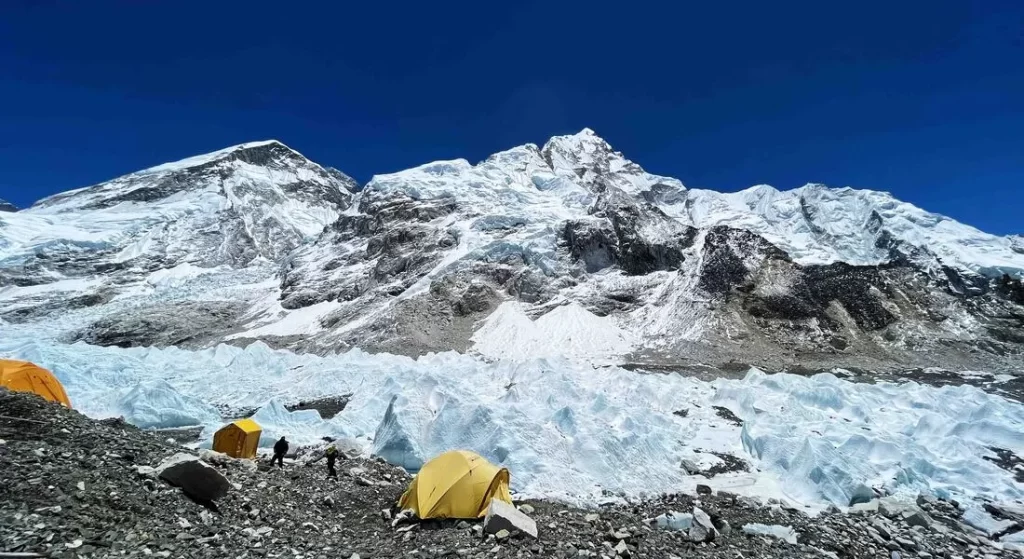
These mountains sit at the very pinnacle of human endeavor. They require an extreme commitment of time, money, and, most importantly, prior experience.
- Prerequisites: You must possess extensive mountaineering experience (often requiring multiple successful Level 3 summits below 8,000m) and deep knowledge of complex rope systems. This is not a learning environment; it’s an execution environment.
- Extreme Logistics: The sheer altitude and vast scale require massive, coordinated logistical support—high-flow supplemental oxygen, dedicated Base Camp and advanced medical staff, and months of preparation.
The Critical Role of Fixed Ropes: Sherpa Expertise
While the 8,000-meter peaks utilize fixed ropes, this does not make them non-technical. The truth is, fixed ropes make them possible for a wider group of high-level climbers, but the climb remains immensely demanding.
The legendary Icefall Doctors and Sherpa fixing teams are responsible for:
- Setting the Route: Identifying the safest (yet still dangerous) path through moving icefalls and up steep faces.
- Installation: Anchoring thousands of meters of rope, aluminum ladders, and protection hardware for the entire climbing season.
Therefore, when you are climbing Everest, you are using the rope as a primary safety mechanism and aid, but you still need the strength, skill, and endurance to ascend and descend thousands of feet of steep ice while battling the world’s most extreme altitude.
5. Your Preparation: Crossing the Technical Divide

The biggest mistake I see, year after year, isn’t fear of the height—it’s underestimating the Technical Divide between high-altitude trekking and real climbing. That jump from Level 1 (walking) to Level 2 (Island Peak) is massive, and it demands a total pivot in how you train and what gear you buy.
A. The Training Shift: Stop Walking, Start Pulling
If you’re only jogging and doing long hikes, you’re only training for half the climb. Consequently, you must shift your focus from passive cardio to functional strength. Why? Because the final 150 meters of vertical ice on Island Peak requires you to use a Jumar (ascender). You’ll be hauling your entire body weight up a fixed rope at 6,000 meters. That is not a leg workout; it’s an upper-body and core brute strength test.
Therefore, your training needs to prioritize:
- Pulling Power (The Summit Requirement): Get serious about pull-ups, weighted rows, and heavy rope work. Develop the muscular endurance you’ll desperately need when you are cold, exhausted, and running on half an oxygen tank.
- Knee & Core Resilience: The descent will brutalize your knees. Focus on eccentric strength—controlling the lowering motion—with deep lunges and squats to handle the relentless pounding.
- Endurance Under Weight: You must simulate the daily grind. Hike long distances (6–8 hours) while wearing a 10–15 kg weighted pack to prepare your body for the logistical load-carrying required between camps.
B. The Mandatory Gear Upgrade: Protect Your Extremities
You can save money on jackets, but you absolutely cannot skimp on your feet. The single most critical investment that separates a Level 1 trekker from a true Level 2 climber is your footwear.
- Trekking Boots (Level 1): Fine for EBC. They’re rigid but lack the insulation necessary for an alpine start.
- High-Altitude Mountaineering Boots (Level 2/3): These are mandatory for your safety. You need plastic shell or high-altitude double boots (rated for 6,000m to 8,000m). Crucially, the pre-dawn temperatures on the glacier pose a severe and immediate frostbite risk, which only this specialized gear can mitigate. Furthermore, these rigid boots are the only way to safely secure and use your crampons.
C. The Decision Point: 6 Months or 5 Years?
Your preparation timeline is entirely dictated by your climbing goal. Be honest with yourself about the time you can commit.
| Climbing Level | Required Prior Experience | Training Timeline |
| Level 2: Trekking Peak | None required (only peak fitness). | 6 to 12 Months of dedicated physical and technical training. |
| Level 3: Expedition Peak | Multiple Level 2 summits, advanced ice/rock climbing courses. | 3 to 5 Years of committed progression and high-alpine mastery. |
In short, the Trekking Peaks (Level 2) are an accessible, achievable goal with a focused 6-12 month training plan. However, the jump to Level 3 (Ama Dablam, Cho Oyu) is exponential. It requires a full-scale commitment—not just a vacation, but a lifestyle change. You must decide where you stand.
6. Conclusion: Start Smart, Climb Safe
Technical mountaineering is a clear spectrum in the Himalayas: it starts with essential rope work and controlled exposure on the relatively manageable Trekking Peaks and advances to the severe objective dangers and highly technical vertical ice of the world’s highest mountains. You now know the difference.
The question isn’t if you’re ready for Everest; the question is, are you ready to climb, not just walk?
If the answer is yes, then the Trekking Peaks (Level 2) are your perfect, achievable entry point. They give you the full challenge—the crampons, the Jumar, and the pure satisfaction of standing on a summit that requires technical skill—all supported by our world-class safety protocols.
We’ve laid out the path, the training, and the mandatory gear you need. We run our expeditions only during the safest, most stable seasons, and our spots fill up fast because our safety standards are the best in the Khumbu.
Stop reading about it and book your Island Peak expedition with Pristine Nepal Treks and Expedition today! Let’s get you on the ice.